Showing posts with label Ernie. Show all posts

Friday, March 8, 2019

40 Days of Fire and Ice - Week 1

Well, it's officially Lent. 

This year as I once again resolve to set aside a few time-waster bad habits, I'd like to make a practice of sharing art each week instead. 

For the next 40 days, I undertake to offer 40 pieces of art: photos, drawings, paintings, fire service insignia, writing, and all manner of love notes to reflect on our snowy and fire-prone Okanogan Highlands, and the fire service teams we will serve with this summer and in future.

For those who haven't heard, the Wisner homestead was sold last fall, and we are preparing to move from our home of 7 years. 

Distance to medical facilities, and the local VA clinic closing, were big factors in the decision.  Both Ernie and the senior Wisners have medical conditions that are slowly worsening, and require regular and sometimes specialized care.
  The economics of being here doesn't pencil out very well either - a lot of our work is elsewhere, and the long distances and sometimes extreme weather conditions mean higher costs when we travel for work, medical, or family visits.  When you add in the hauling requirements to get a 30-foot fishing boat over the Cascades every time our salty sailors want to chase the salmon, cod, or tuna ... Captain Ron decided it's time to be closer to the ocean again.  So Ernie's dad and stepmom have sold the land, found themselves a house in Coquille OR, and Ernie and I are looking for options in that general area.

It is difficult to leave this place, after getting attached to it all.  My sit-spot by our pond, my fire hall crewmates, the gorgeous landscapes.
And there are the dark corners to clean out: unfinished projects and accumulated clutter to sort through. Thinking we would be here a long time, we have allowed ourselves to accumulate half-finished barns full of drifts of tools, materials, and hand-me-down posessions that we will need to deal with.

It is also difficult to see where exactly our next move will take us, from here.  I want to continue in fire service work; I want Ernie in a safe place where he can continue to be as involved as his health permits; ideally, in a nearly-ADA home within redneck-wheelchair (ATV) range of essential services and family/trusted companionship.  With room for a 60-lb dog who can jump a 6-foot fence if he feels he's on the wrong side of it. 
Selling the property provided just enough to get Ron and Jeanine situated in Coquille, but did not leave any extra for Ernie and me to make our own down payment on a new place.  So we're starting over again, hoping the money for the move (and a new residence in a higher-value area) will show up as it's needed, mostly from what work we can do or surplus things we can sell along the way.


Once we get our feet on the ground, I do have summer wildfire work lined up, and ongoing plans to keep working toward higher qualifications and pay rates as a fire fighter.  My wildland contract crew of the past 2 summers has trucks in Oregon, and are delighted to have me available down there for this season.  The boss has signed me up for higher-level classes this spring, that could lead to a pay raise and/or instructor qualifications within the next couple of seasons.
So the daunting thing about the transition is not the lack of a future path; more the speed it needs to happen, the amount of clutter (including Ernie's mom's stuff) that needs to be sorted and cleared; and the risks of overspending and overcommitting on a rental or mortgage in order to find a place that feels right for us.

I'm seeking inspiration and moral support for the move by celebrating the things we love about our work, and the place(s) we live and will live. Please enjoy these photos, artwork, and other creative reflections on this phase in our lives. 

And if you feel moved to help, or called to share an option with us, thank you.  We appreciate your solidarity.


What is Lent:
In the Catholic / Western churches, this is a time for fasting, reflection, giving up unhealthy or unneeded luxuries, and instead sharing surplus in solidarity with the poor.  Religious themes include Jesus' fasting for 40 days in the desert, and the wild ride of hopes, fears, betrayal, and bewildered expectations that leads up to the Last Supper, Crucifixion, and Resurrection.  (Celebrated at Easter.)

These last months of winter, many other traditions also reflect on themes of hunger, solidarity, survival, and the longing for spring's renewal, cleansing, rebirth.  I remember seeing a Native American calendar at Timberline Lodge on Mt. Hood, that described February/March as "The Hungry Month." 
You might think that the darkest part of winter in December or January would be the hungry times - yet we often coast through the winter solstice with merriment, harvest and holiday feasting.  New Year's comes with hopes and grand plans for how well our snowblower will work, how we'll exercise more while still getting everything else done, and how quickly we'll get our tax paperwork done in January.

February is when we start asking each other, "This might be the last snow, do you think?" 
March is when we start to think about selling the blamed machinery before something else breaks... until another 6 inches of snow makes us double down and keep it working.

When I sat down to pray recently, feeling particularly sad at leaving my crew, and so many high hopes, plans, and unfinished projects, this reading came up:
John 13:1-14, the one that starts:
"It was just before the Passover festival.  Jesus knew that the hour had come to leave this world and go to the Father.  Having loved his own who were in the world, he loved them to the end."
The story continues, describing how the Lord took a towel and washed his disciples' feet - while making it clear to them the role reversal from master to servant was a deliberate example for them to follow. Love and serve one another, as I have loved you.

Took some time yesterday
to apply the decal
onto another fire truck. 
Technically counts as art
because I helped design the logo. 
Definitely counts as supporting and serving
alongside my fire chief and crew.
That's a pretty basic message, coming from a pretty extreme situation.  Comforting, direct.

So as we pack, I will be reminding myself that moving is not the hardest sacrifice, not by a long shot.  But it is a transition; and an opportunity to find ways to finish our time here in a way that honors all we've loved about being here, and supports those we care about as we go.


Flag and shirt design
for this winter's Wenatchee fire academy

"Ladders on Ice"
was an alternative proposal for our motto.

Wednesday, October 25, 2017

Well, that was an adventure ...

August 31, 2017: Call Bill Duguay of Methow River Wildfire, ask if he'd be interested in another crew member for the tail end of wild fire season.

September 4: Finish new hire paperwork for Methow River Wildfire

September 5: Dispatched with MRW engine 10 to Norse Peak Complex, Snoqualmie WA.  Serve 11 days under engine boss Clayton, mostly structure protection.  (Soundtrack: Reggae, hip-hop, and chainsaws...)
Clearing fuels back from structures
A charming bark-clad structure


Family cabin with Mom's garden and Swedish wood stack

Silver fox says, "This is poopy."
Morning briefing
Standing by for structure defence
Helicopters run water to steeper slope areas
Fire rolls down toward our previous location;
the structure-defence lines hold.


Sept. 18: Relief crew replaces us; caravan 6+ hours home to central WA.

Sept. 19: Sleep, wash socks, eat

Sept. 20: Dispatch calls regarding Umpqua North Complex, southern Oregon.  Proceed in the morning to Wenatchee, meet engine boss Judy and crewmate Damien.  Long, funny, 10-hour road trip down Route 97.  Last 4 miles to fire camp, we are passing by snow on the ground.  Boss suspects we may not work very long, if at all.  *My cell phone quits getting service for some reason.


Morning frost, flagged-off muddy road, and a chipper
Sept. 21: Staging/IA = wait out the rain, and sometimes snow, in a gravel lot near the temporary heli-spot.  On the third day, I become restless and collect some of the larger rocks into a stone chair. 
Crewmate Damien tries out the stone chair
Hiking into burn area
On the fourth day, they send us out to unwrap "cultural sites" and repair hand lines.  By day 6, we are working 8 to 12 hour days feeding wood chippers; along with another MRW engine and crew.  When most of the trails are repaired and the management team times out, they disband the camp and send us home.  Total of 10 days.
Needle fall covers charred ground

Masticator \ excavator
Nicknames earned:
"SuperNanny" (due to frequent provision of spare paper napkins, map/route details, snacks, and hot cocoa for mocha upgrades when the food tent ran out)...
"Stonewall" (from a charming equipment driver who enjoyed watching the armchair masonry).

Sept. 30: Another 10-hour road trip home: engine to Cashmere, convoy to Wenatchee, drive myself home from there.

Oct. 1: Sleep, wash socks, pack.

Shadow of deer in dust
Oct. 3: Load myself, Ernie, and Radar in the station wagon, head for Montana. *6:30 pm: stop in Colville to buy a pre-pay cell phone for travel safety.
8:05 pm: Large, white-tail buck emerges from the darkness - takes out 3 panels, driver side mirror, and windshield of station wagon. 
White tail hairs, dog leash

8:10 pm: Call insurance, lash rear door on with dog leash, limp back to Colville, find motel, call home.


Oct. 4: Phone calls, body shop, backtrack. 
Estimator warns it is likely totalled, describes the car as non-drivable despite apparently intact engine, wheels, and drive train.
Highlight: he explains to insurance claims agent,
"Technically, if zombies were coming and we had to get away, we could use her car ... but [describes damage] ... short of a zombie-level emergency, I would not recommend taking it on the road."


Load car contents into Ernie's dad's pickup, say goodbye at body shop. 
3 hour drive back home.

New car, as seen in daylight
Oct. 5: Phone calls, carry water, chop wood.   Discussion; Internet; more phone calls.  Get final numbers from insurance and bank, call dealer, pile back into pickup, drive 3 hours to Wenatchee.  Decide on a new car 5pm-6pm, load gear, paperwork.  Reserve hotel near Spokane, drive 3 hours, sleep.

Oct. 6: More paperwork until 1pm, finish drive to Montana.  Arrive 4:30 pm, prep, present our first session on schedule 6pm.  (Fire Science Theater).

Casserole-lid door:
thanks Uncle Mud!
Oct. 7-17: Rocket Mass Heater Innovators' Jamboree.  Enjoy watching Donkey and Uncle Mud get to know Paul & co.  Build unique slider door with extensive bubble-gum welding; help it be upstaged by a thrift-store casserole lid.

Paperwork continues (taxes, notaries, etc).

Oct. 19: Field trip to Missoula Fire Science Lab, take colleagues to airport, shop for hardware and fire gear. 

Fire service quilt

Fire behaviour test bed

'Recorder tree' marks historic wild fires

Oct. 20: Pack, clean up, Spokane VA, then home.
(6.5 hrs road time + 2 hrs medical/food stops).

Oct. 21: Sleep, wash up, eat, finish book. 
Fire chief calls with update, next tasks for fall.

Oct. 22: Work on commission from Spirit of Grace.  Trap 6+ mice.  Take Ernie's dad shopping in new car, obtain mouse-resistant storage containers and enzyme cleaner.

Oct. 23: Formally declare War on Mice, first battle: the bathroom.

Oct. 24-25: Back to work: office, wintering in/repairs, meals, dishes. 
Catch up with all you lovely folks.


What's next?
- Remodel experimental rocket stove in northern CA
- Set up Portland visits with family, friends, colleagues, clients
- Catch up on fire hall business
- Line out winter work.

Monday, May 22, 2017

Getting our wild geese in a row

Ready... set... LAUNCH! 
(the lead gosling is already in over its head)
We are getting ready to head to Montana for most of a month.

Arranging for things to thrive during our trip - Ernie, me, Radar, and whatever else fits in the car; and the plants and homestead while we're away.

Taking a few more pictures of goslings before they outgrow the adorable fuzzball stage.

All lined up and taking care of business...

Flotilla in excellent formation


(Ernie is getting pretty good with that new-to-us camera, these are all his photos.)


Paul's Kickstarter for our Permaculture Design and Appropriate Tech courses has less than 48 hours to go.  They are installing a dedicated, separate internet link for streaming live video and chat from these courses to online supporters.

We have been warned that with over 40 people on site for these courses, the regular internet for other business may be slow.  So I likely won't be able to post in-person updates from Montana.  I've pre-loaded a couple of things for you while I'm gone.

If you'd like to follow along, now's the time to sign up for that Kickstarter before it closes.

Here's the link: https://www.kickstarter.com/projects/paulwheaton/live-stream-permaculture-design-course-and-app-tec?ref=ap8ze3


...
"Please form two lines as you exit the flotilla..."
Ernie's dad paddled the canoe out today, and measured the deeper part of the pond.  7'6" of water.
It's within a couple of feet of the highest he's ever seen it... and probably twice as deep as I've ever seen it, as it's been during the past 6 to 10 dry years.

Which means the gees actually have TWO islands, although the moat for the new one is a lot shallower than the old one. 

Yay!
Water in abundance, and a good place to put it.

Monday, August 22, 2016

Countdown to the New Normal

If our bodies made logical sense, we would be robots.

A lot has happened since I wrote the posts for May - including some lovely professional opportunities, re-connecting with old friends and colleagues, and making new memories.

But in the last couple of months, the excitement about bringing out The Book has been overshadowed by health concerns.  We have two relatively urgent medical upheavals in our lives right now. (Along with the usual number of chronic concerns, if there is such a thing as "usual number" of those.)

One is the news that Ernie's mother Peggy has had a serious downturn in her longstanding battle with cancer. The other is that after trying a lot of alternatives, we finally have been referred to an excellent surgeon, who says there is a very good chance of a successful below-the-knee amputation for Ernie.  This is a HUGE decision, but it's one that Ernie has already researched, and made up his mind a few years ago was the next logical step to move forward.

(The weeks between organizing Peggy's hospice care, and going to meet this new surgeon and find out what was possible for Ernie, have been a VERY difficult time to stay focused on work tasks.  But now I seem to be back in the saddle for logistics and follow-through.)

If Ernie's insurance gives the green light for this surgery, we need to allow for a year to 18 months of post-surgery recovery and adaptation.  After that, we get to discover our "new normal." 
  We can look forward to possible reductions in pain (currently between 7-10 pain level most days), and significant reduction in the infections he's been experiencing the past year and a half. 
  I hope we can enjoy a lot more water-sports (many amputees are active kayakers, sailors, and swimmers), and better options for bicycling again.  Most travel should become significantly less painful and risky, as well, though we may need to be stricter in our criteria for ADA-accessible destinations.

We have also been warned to expect that construction, especially lifting, twisting, and balance-type activities, are extremely difficult after any leg amputation. The prosthetic socket represents sort of a bendy break in the lower leg, which is a weak point under sideways stresses such as torque, bending, or shear (unstable as well as very uncomfortable).  The surgeon and prosthetist we talked to have worked with a number of drywallers, builders, firefighters, and fishermen, and these folks rarely return to the same work after an amputation.  (The longest example the surgeon has seen lasted about 2 years at drywalling, and that was a guy who was highly motivated to keep supporting his family.  It was just extremely difficult to do that kind of work.)
  The most successful people in adapting to life after amputation are good "outside the box" thinkers, who can find new ways to perform familiar tasks now that their body has a new shape and new limits.  We all agreed that Ernie is very likely to remain well above average activity levels; he is intrinsically highly motivated, and highly adaptable.

You can imagine this involves a lot of discussion about our work and life together.  We may be sending me alone to honor some existing commitments, and identifying and cancelling those optional things that have to give way to higher priorities. 

Ernie wants to "support me" in going ahead and doing things without him, things that might take my mind off all this, like fire fighting, book signing, and scheduled events where I get to shine as a featured expert. 
However, I find fame is a poor substitute for creative partnership.  Performing under the limelight doesn't come naturally to me when my heart's priorities are on what's going on back home.


I've resumed mutually-supportive dates with two of our local friends, and phone check-ins with a couple of family members.  A few regular people who ask me how it's going once a week, and especially those who don't mind taking the time to discuss detailed work logistics, family concerns, and other problems, are much appreciated.

We had a lovely "angel visit" from our friend Tyler this weekend, who helped with construction (see next post) as well as prep and playing with natural plasters and goat cheese.

I'm currently organizing my chore lists, so I can delegate somewhat in case of offers from other angels with time to spare.

Yours,
Erica (and Ernie) Wisner

Saturday, March 19, 2016

We Are Doing It! Kickstarter Thanks, Teeny Tiny Labs, and a Pine Cone Wood Stack

First, thanks for helping us reach our make-or-break funding goal on the Kickstarter!  From here out, it's real: we can expect to collect those pledges and deliver those rewards.


In case you're curious (or jealous):
In business speak, the big numbers you see are "gross" not "net."  That $13,147 you've all graciously pledged is not just spending money.  It includes the daunting costs of international shipping, per-book costs for every printed and eBook (as "Author Copies" from the publisher), and data delivery costs for the self-published digital rewards. 
In order to move our plans forward, and maybe even give ourselves some 'back pay' for the past decade of R&D, writing, and coaching, we need to keep going.
Two cream puffs, ready for breakfast

So we will keep drumming up as much business as we can for the remaining 24 days.  I'd like to sell over a thousand books, and get our per-book costs way down - it would save us something like $8 per book to order 1000 copies instead of 100!  Which adds up to real money, really fast.

But let's not forget to celebrate how far we've come.  It's a big deal to be officially "funded," many projects never get this far.  So...
 Yay!  Basic Goal Nailed!  Cream puffs for everyone*! [*who is currently here at the Wisner family homestead]

Our first stretch goal:  $20,000 = Teeny Tiny Lab

GlowBug - photo by Priscilla Smith
We always need more funds for research and equipment.  If we reach $20,000, everyone who backs the Kickstarter will get designs for a Teeny Tiny Mass Heater (such as you might be curious about for a well-insulated Tiny House, shop, or live-aboard boat).

There are more details on the Kickstarter updates, and you may also remember seeing some tiny heater prototype designs at the 2015 Innovators' Gathering. This stretch goal encourages me to finish testing and write up those designs, so you can replicate them and try them out.
(I have older mini-mass-heater designs already available, if not as rigorously tested, so I can fulfill this reward either way.  Just saying, you might get more than one mini-heater design if the response is good, and always assuming I get a chance to sit down this year.)

The main idea of this funding goal is to have fun giving us a teeny tiny lab upgrade, so we can do more Mad Science!


I would like to take a moment to acknowledge a few friends.

- Our friend Paul Wheaton, the brilliant and despotic overlord of www.Permies.com and www.Richsoil.com.  He has been sharing all kinds of support and tips and encouragement, despite being laid up with a nasty health crisis.  His lessons from previous Kickstarter campaigns, both good and bad, have been invaluable. 
He also has been generous in other ways - like one time he got tired of watching us thumb-text and gave us a fancy second-hand phone.  It has saved our butts this month, since just before your big launch is a crappy time to have your pit-bull-in-law develop a taste for phones.

- Our new friend Priscilla Smith, who came out to Paul Wheaton's place and got some excellent photos of everything - three of which are in the book, and others are being used as "don't-try-this-at-home" eye candy for the promotions.  She is generous, talented, and a kick in the pants.

- Our new-and-old friend Chris McClellan, aka "Uncle Mud," has been promoting the heck out of our Kickstarter, and may be helping us print another self-published run of The Art of Fire.  He's currently #1 on the Kickbooster stats - as he has been since about 4 hours after he signed up.  And his "dad humor" and unique rocket experiments keep cheering me up just when I need it.

(Paul Wheaton may not be catching up yet from flat on his back, but Permies.com is our biggest non-boosted referral source, right after "no referrer data" and already beating Kickstarter itself.  If you'd like to try signing up as a Booster and track your influence, not to mention get a referral bonus, please do:  https://rocket-mass-book.kickbooster.me This can be a fun "egg money" option for creative, modern homesteaders.)

- Our chance-met friend Matt Powers just keeps on being a wonderful human being.  I hope he and his son James can wander up to Oregon in June and hook up with us for a clamming expedition or a bonfire date or something.  He anticipated our launch by about 24 hours with his fast-turnaround podcast featuring me as a guest, and Barbara Greene's photos of her permaculture homestead's fortune-favors-the-prepared survival of the 2015 Okanogan fire-storm.

- Barbara, Leaha, Ton, Karen, and all of our Permaculture Study Group friends from the Okanogan - invaluable moral support, brainstorming and occasionally physically helping me get past stuck points, and keeping me healthy and active with mentoring in fire fighting, land stewardship, and local culture. 

- Extended family: reminding me again and again why it's so great to have a clan at your back, and to re-discover your siblings as creative, intelligent, capable adults.  Together we are more than we could ever be alone.

- I'm gonna plug my other half here, and say Ernie continues to impress me.  He rarely self-censors on Facebook for anyone's comfort, which occasionally makes me cringe - but that honesty is refreshing to a lot of our die-hard DIY fans.  Then I notice yet again how much he does without words, when I am fluttering around in a verbal blizzard of writing or publicity projects.

This is his "pinecone stack," basically a wood haystack.  This is an experiment to try and replicate a method he remembers seeing from Uncle Les, one of the forest-homesteaders in the Coquille Valley rainforests.  (His family has been managing the same forest, for timber, for over 150 years, and it still has mother-giant nurse trees on it.)

The stack is busted open so you can see the inside, because it was put to the test this month.  While he was stacking roughly a ton and a half of wood just for fun, I was neglecting my summer woodshed-filling chores, working on the book manuscript, and learning to play fire fighter.

The partially-used stack. 
The bottom row is intact
because it was snow-saturated.

Interior - note the "nest of approval"
The bottom row has some sacrifice wedges to start the stack tilting inward.
Each course is built in rings that tilt inward, like a haystack.  As much as possible, the logs are tilted to lap slightly over each other, like shingles.  The bottom row is tilted up on wedges to make for a stiff, tilted arrangement.

Getting an earlier start on my chores this year:
filling half the woodshed, so we can cycle each side.
When we busted into it for emergency wood supplies, the outer bottom course was completely buried in snow, and those logs are still pretty soggy.  I've been moving them to the woodshed to dry for next year.  The upper sides, on the outside, had 2 feet of snow on them, and I've been moving them to the wood shed too.

But the inner layers, protected by those sacrificial ones, are about as dry as you could hope to find in a coastal woodshed. Not quite as bone-dry as things get in a drought summer around here, but way better than the icy punk we gathered before buying a load of decent wood that first winter.  The "nest of approval" is some synthetic blanket stuffing that some critter apparently found in the trash pile, and dragged into the dry center of this wood stack to make itself a cozy den.  I can just imagine a pine squirrel opportunistically pretending to be a "snow beaver."

When we are rushing around in spring and fall, doing workshops and site visits, or attending to Ernie's leg's medical demands after an ambitious travel season, we don't have the luxury of a normal, seasonal homestead season.  Two of the 4 years we've been here, we've had to "winter in" by mid-August.  So I am learning to treat wood storage as a spring chore, or to try and get in 2 years at a time so I can slack the next year.
(Tried that this year, almost made it.)

The wood had been in the woodshed long enough, still gappy between the rows for air flow, that some other pine squirrel had decided to pile a bounty harvest of fir cones in between the rows.

While Ernie is celebrating the success of his lumberjack experiment, I have been hauling in some of the bounty of fir-cones, and chipping down knobby branch and stump pieces, so we have some dry material to mix with the slightly-damp stuff.

I've also been splitting down some of the almost-dry wood as I bring it in.
Wood over 6" diameter is considered "thousand-hour fuels" in fire fighting, meaning it takes months to appreciably change its core moisture levels.
So if I can get it down to 2" chunks, it becomes "100 hour fuels," and I can expect it to be reasonably dry in less than a week indoors.

Still not a great process.  I'll do better this year.

In our next blog post, I'll show some good woodshed designs, and some good and bad ideas with tarps.

Happy Almost Spring!
Thanks again for supporting our book launch, in so many ways.
If you haven't done so yet, please check it out:
 

Monday, March 14, 2016

The Grateful Brain (thank you Kickstarter surge!)

Just thanks.

I woke up this morning, after sleeping less than 5 hours, wanting to write you again.
Paddling as fast as I can, 18 to 20 hours a day, I am still not quite keeping up with all the timely suggestions, offers of help, and messages of support.  While I've been told to expect the Kickstarter momentum to drop off after the first 3 days, it seems to be still going.  Yes, please, more!

Thank you all for the tremendous outpouring of support for our new book.

I've received some of the nicest compliments on Facebook, email, and all the websites from old friends, new friends, and perfect strangers.  The folks who bookmarked our Kickstarter profile a year or more ago have been scooping up the early bird rewards faster than I can get the announcements out to the rest of our audience.   We're starting to get visitors from the "popular" and "trending" listings on Kickstarter.

As each step gets done, and the project begins to move forward on its own, I felt a sense of release. The "weight being lifted" metaphor is trite and true.  It's like pushing your arms against the sides of a doorway for a long time, then stepping forward and trying to relax.  (Try it!)  It's like a glowing retinal after-image of self-imposed anxiety, where there is this momentary, fading awareness, along with the opening look new things as it fades.

Since the launch, it's gone from a floating open feeling, to a profound sense of support.
You have my back.  You care.
Thank you.
I'm deeply grateful, and it's highly motivating.

This is a wonderful feeling, and pure self-interest has me wondering what else I can do to keep it coming. 

This is probably the single most valuable thing I can offer, more so than any physical help or technical information.

If you want to know more about the power of gratitude, read this article: The Grateful Brain.  It offers scientific evidence that gratitude is not just an altruistic or pleasant feeling; it is a functional anti-depressant, and a literally and physically empowering state of mind.  Science once again 'discovers' and proves out what traditional wisdom has been saying for millenia.

Ernie tackles a confidence course during the IDEO program

It's like human nature is wired so that when we help each other, giving and reciprocating favors, making gratuitous acts of kindness and decency, we become more powerful and determined in our own work.  Fear and anger make us weak, while feeling grateful and supported literally makes us strong.  I learned this from a behavioral psychologist and Marine veteran at the Center for the Intrepid; if you dismiss this as woo-woo, you are missing the boat.
Seeing our book take off is a little like seeing Ernie walk again without crutches after 8 years. 

So I want to share with you the most valuable lessons I took from watching the IDEO program, and Ernie's cohort of courageous survivors pushing through setbacks to rebuild their lives and physical grace:
Gratitude.  Vitamin D.  Give back. And never give up.

Ernie escaping into the wild

(See previous posts about the IDEO program)

Your tremendous support doesn't mean we are going to just coast from here.
On the contrary, our gratitude is going to intrinsically push us to do more and better things.  Can't help it.  It's our biological nature. ;-)

Your support doesn't mean that we are going to coast from here.

We have a commitment from a world-class publisher for the overseas English version of the book - which means we'll be able to offer better shipping rates or even a whole different package for our international supporters.  And we'll be scrambling to make sure the data is correct and relevant for those regions.  If you're in the EU, UK, Australia, New Zealand, or outside North America, let us know if you have any last-minute questions or input for that edition.  International supporters might want stick with the digital Kickstarter rewards for now, and keep your eyes peeled for announcements.

Many, many possibilities are unfolding. We're more than halfway to our minimum goal, and I am preparing to post the first stretch goal.

Chime in on what you'd like to see! This grateful feeling has me itching to give back in more ways.

I know many of you share our commitment to building stronger, more resilient communities; empowering people to get their hands dirty and build skills and problem-solving competency; and taking one bite at a time out of the "elephant" of global problems.  (Thanks for that metaphor, Deston!).

Aligning our individual projects and efforts makes a bigger contribution to solving global problems.  Your wishes are very good indicators of how we can give better service, and make a difference.

So please keep the comments coming.  What is one more thing I might be able to offer you - or your friends and family, or your community?


Thanks again for reading these updates.

May your dreams prosper as you share them with others, and may your earnest service bring unlooked-for blessings.

Yours,

Erica W


If you haven't yet found the Kickstarter to place your pre-order, click on this link:
https://www.kickstarter.com/projects/rmhbuildersguide/the-rocket-mass-heater-builders-guide

If you're not getting our newsletter, email me.  questions@ernieanderica.com

I have one list for general interest (like this blog), and one that's specifically for dedicated rocket mass heater and wood/fire/masonry enthusiasts.  I sometimes put out special offers there, like in-kind collaborations, beta-testing, or draft resources for review, that I don't release to the general public.


For those outside the USA, please read the FAQ for alternatives to costly international shipping.  This thorough book is, understandably, somewhat heavy (it's 296+ pages, including the appendices and index).


Or you could sign up as a booster, like many of the rocket-stove regional leaders are doing.  Uncle Mud is currently "winning" at booster referrals (go Chris!).  International customers may be able to pay back your physical book/shipping by encouraging your friends and neighbors to chip in at some of the digital rewards levels.  (Kind of a pyramid scheme, I guess - but we only have four weeks left, it's not like we can reach every person in the world without your help.)

Thanks, Teresa, for the word for "Natural alignment" marketing.  The idea is that if we can count on our readers who naturally care about us and our work, to share this info thoughtfully with others who will naturally appreciate it, then everybody has fun.  It's a lot less annoying (and more effective) than bulk marketing. 

I have been getting cold-calls, emails, and Kickstarter messages offering to Tweet my stuff to Over a Million Subscribers for only $14.95! But if I don't have any relationship with those people or know what they like, what good would that do our reputation?  And how many of them would really like or support our work, compared to the ones that have a negative reaction to us as are another annoying ad?  I assume that our actual friends who actually use Twitter are actually re-tweeting (I have to go do a Tweet myself, haven't touched my account in way too long).  And I'd rather rest on natural appeal than scuzzy marketing.

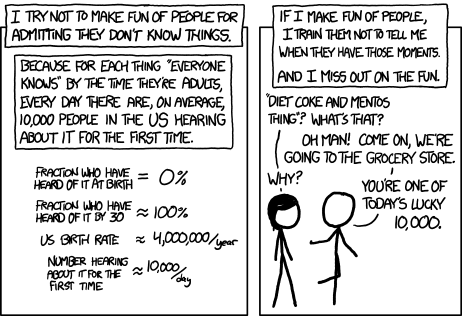
I would love your comments about clever twists on our natural appeal.  Anyone who has visited us or our clients, and melted into a rocket sofa, knows why this is cool.  But according to xkcd, there are something like 10,000 new Americans every day who are learning something for the first time that "everybody knows."
Ten Thousand

I'd love your ideas for how to present our work in ways that appeal to those thousands of people, for whom this is a brand-new discovery.

It would be really crappy statistics to extrapolate that we should reach over a quarter-million people in the next 28 days, but heck, let's go for it!

Let us know if you have ideas for more digital rewards that would be especially useful - for international work, for friends, would you like a special home-schooling package? 

You know our work is much broader (and stranger) than this book alone.  and our digital rewards can reflect that.

It's an honor and a pleasure to work with my wonderful clients and supporters.

You rock.

Sunday, March 22, 2015

Equinox II: Urgency and Importance

So Ernie says I tend to talk more when I'm stressed.  I think it applies to writing, too.
Hence my "quick equinox update" has turned into two posts, both plenty long enough. 

Especially when stressed or feeling a sense of scarcity, it's easy to get tunnel-vision.  The perceived scarcity hijacks the mind, causing us to focus on immediate, urgent concerns, even when they're not the most important.  (I really liked the book "Scarcity" and its insights into these problems.)

Urgent is time-sensitive: paying the bills, getting more wet cat food (even when there's plenty of other things to feed the cats, including mice).

 Important but not urgent might be taking more steps toward a sustainable and satisfying career, deepening relationships with loved ones, managing chronic health conditions, or getting out from under a high-interest debt.  It's easy to put things off if they don't come with a specific deadline, but the cost can be high.
Splitting the wood - 2013-14

One classic example is laying in fire wood.
Lighting the fire today feels urgent. (I have not been running the heater as much since we are down at the hospital for Ernie's care.) 
Today, I grab enough wood to start the fire, and stay warm. I split just enough for today.

Important, but perhaps not urgent, is drying enough firewood this year to provide for next year.  If the wood I split still feels tough and clingy, not yet fully dry, I set it aside.  (My fault for deciding to stack whole rounds instead of splitting earlier in the year; now that they're split, they'll be ready for next year.)
I take a moment to bring in a few wet logs that have been rolling around since last year's harvest, and stack them on the empty side of the shed along with the new-split wood.

I also find, just peeking up above the current stack, a little stash of kindling Ernie left when we stacked the wood last summer.  Normally he splits kindling every couple of weeks through the winter, and we have a little shielded cubby for it near the stove.  But while I was telling the guys to just stack rounds, we can always split it later.... Ernie laid aside a few days' worth of kindling way back in the woodpile, just to make life easier some day in the future.  And that turned out to be a blessing this week.
A Providentially-timed gift from our past selves: Ernie taking care of things, whether or not he's able today.

Firewood is a great example because like so many concerns, the earlier you address it, the more effective your efforts are.  If you harvest green wood in winter, it takes more than twice as much to stay warm.  If you store 4' logs instead of 15" splits, it may take ten times as long to dry.  If you are burning split cordwood, it is easiest to split either fresh and green, or bone-dry and checked - in between it turns all leathery and tough.

Burning wet or green (uncured) wood forces the fire to boil the wood dry before it can burn, and the evaporation uses a huge amount of the heat from the fire. Sometimes the resulting steam puts out the flames causing half your fuel to follow it up the chimney unburned as smoke or creosote. 

Whenever people ask about burning whole, long chunks of logs, it makes me think they are focused on the urgent, just-in-time method of wood harvesting.  Logs don't dry well, so you need a lot more storage if you are going to wait until they are dry to burn them.  Or you need to haul about 4x the weight to compensate for the reduced efficiency and the water weight of the wood. (Roughly 2x to 3x by volume.)

How much storage do you have for logs? In wildfire risk assessment, standing-dead fuels are rated as “1-hour, 10-hr, 100-hr, and 1000-hr” meaning it takes that long for them to adjust to the surrounding moisture level, and become more or less likely to ignite. I would roughly double that time if what you want is a clean, efficient fire with no smoke.


“FUEL CLASS:
A set of fuels with similar traits. Fuels are categorized as herbaceous or woody and live or dead. Dead fuels are classed as 1-, 10-, 100-, or 1,000-hour timelag fuels, based on the time needed for fuel moisture to come into equilibrium with the environment:

1-hour timelag fuels: Dead fuels comprised of herbaceous plants or woody plants less than about 0.25 inch (6.4 mm) in diameter and the surface layer of litter on the forest floor.

10-hour timelag fuels: Dead fuels comprised of wood from 0.25 to 1 inch (0.6-2.5 cm) in diameter and the litter from just beneath the surface to around 0.75 inch (1.9 cm) below ground.

100-hour timelag fuels: Dead fuels comprised of wood from 1 to 3 inches (2.5-7.6 cm) in diameter and litter from around 0.75 to about 4 inches (1.9-10 cm) below ground.

1,000-hour timelag fuels: Dead fuels comprised of wood from 3 to 8 inches (7.6-20.3) in diameter and the forest floor layer >4 inches (10 cm) below ground ( National Wildfire Coordinating Group, Incident Operations Standards Working Team 1996).”


1000 hours is roughly 40 days, a month or two. 

So when I see a pile of 3 to 8” logs on the ground, being carefully kept moist by a tarp over top of them, I think, “There is some wood that will grow mushrooms before it ever gets dry enough to be worth burning.”

That's an old rant, and one you've probably heard from me before.

The bottom line is, if you can stay focused on handling the important things, a little bit each day, instead of waiting until they are urgent, you will save time and effort in the long run. 
If you put a few of those logs to work as a good woodshed, and fill one side as the other one empties, you will probably only need about half the fuel each year.  That's a big savings.

I think the same principle will apply to doing little tidbits of work from the hospital, the boat, or wherever you happen to be, and hoping it all adds up to being in a better place when we come out again.

Yours,
Erica and Ernie

Monday, February 16, 2015

Puppy and productivity

Puppy being sent off to play with Ernie, week 1.
Paradoxically, a puppy can have positive effects on productivity, despite requiring time and attention in itself.

It's partly due to starting the morning early: this little fellow-being starts twitching at dawn, and you can either go outside and play together in the morning light, or you can try to sleep through the lavish attention-getting efforts, and the implied threats of soiled floors and ravaged rubbish.

He's almost house-trained, and still managing to fit himself through the cat-door most days, so I could roll over and hope for the best.  But he doesn't really come with a "snooze" button.  Except sometimes if we go outside and then come back in while he's still sleepy enough to snuggle. Once he's fully awake, he needs to play hard for a while.

Sunset puppy kisses
If Ernie or I gets up every few hours to play outside and tire the puppy out, I can then focus on work for a couple hours while he's sleeping.  This makes routine non-urgent work into something that needs to be done within a specific time window, specifically NOW, while the puppy is being entertained elsewhere, or asleep.


And getting up every few hours reminds me of my own biological needs, which means on balance I probably spend more of the work day well-fed, refreshed, and able to focus on work.  It makes me realize just how often I doggedly kept trying to muddle through tasks in a low-blood-sugar fog, or with a pissy attitude.  News flash - it's hard to concentrate on anything when you need to pee.

We'll see if the effect continues as he grows, and needs to be trained or given distracting tasks instead of naturally sleeping so long.

The next couple of months are going to be important ones for productivity.
Our friend and collaborator Paul Wheaton has launched his Kickstarter, which means we will launch ours in less than a month, if we keep all our ducks in a row.  (We coordinate the timing to enjoy the full benefit of Paul's considerable online promotio resources.)
 While we don't directly benefit from his current project, we are featured in it, and his success is likely to lead to more resources coming our way in the very near future.  It's a series of videos covering the recent work on 10 different rocket stove and rocket mass heater projects at Wheaton Labs.  We designed and led the work crews on at least half of these projects, so this will be another Ernie-and-Erica showcase.


We are getting things together to improve the video for our upcoming Kickstarter as well.
We had Chris McClellan print us a proof copy of the book, and Bryce Phelps did a little video segment showing turning the pages.  Nothing like a little extra "real-ness" for the video.  The actual book may go through a whole 'nother layout process, but at least you can see it!