OK, so I imagine you already have your own opinions about global warming, or climate change, or climate wierdening, or whatever you want to call it.
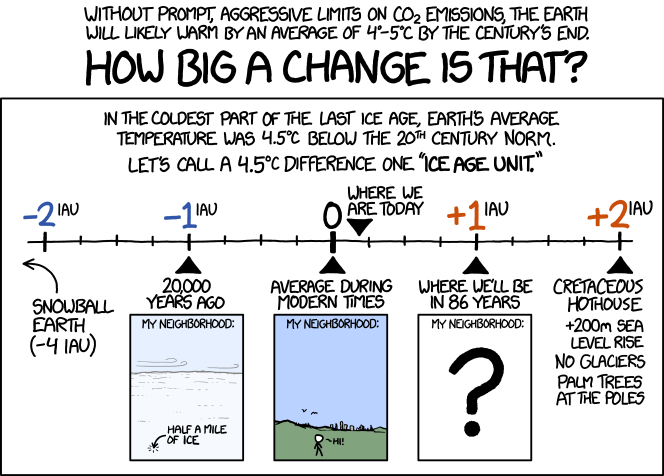
But today's XKCD panel puts it in pretty stark terms:
The short version of this post would stop here.
But I'm not that good at stopping.
So here's The Long Version:
Don't mis-read the scale above; it's easy to think of the ice age as "recent past" and "really cold but there were people alive"; and the question mark seems equally unknown as "the future."
But the ice age benchmark, 20,000 years ago, is a long time. We are not entirely sure where there were people on the planet at that time, let alone what type of civilization they had. The ancient civilizations we know much about are
all less than half that age. Most are younger than 5,000 years (ancient Egypt, Biblical Genesis, Babylonia). None of them ate mammoth, or even had mammoth elephant legends.
"The Future" - 86 years from now is a really short time, considering. Those of us saving up a college fund for our future kids, or trying to reforest a patch of land, would like to imagine that we have some idea what the world might look like 86 years from now.
86 years is a weird estimate to see for geological events. Usually it's more like, you know, "In the next 20 to 200 years,..."
In geological terms, I have never yet seen an accurate 5-year-plan, let alone a quarterly forecast, that considers the effects of volcanoes, weather, or continental drift. Even El Nino and La Nina aren't that easy to predict, though they do give us some idea of what trend to expect compared to 'average'.
Climate averages, like sea level, tend to change in increments that we would consider catastrophic bumps. The idea of watching your local beach slowly erode is a lot less
scary than the realization that many of these changes will literally
happen overnight, in large, populated areas. Ice sheets do melt and freeze a little bit each year, but they also fall off Antarctica with a big "whump" the size of Alaska.
Consider how all factors like sea level rise, sea surface warming, and devastation of marine ecosystems interact in an event like Hurricane Katrina. Larger patches of warmer sea water, just those few degrees from 28 to 30 C, translate to more rain, stronger winds, higher storm surge crest, more flooding inland. It doesn't help the way our coastlines are developed: forces can be focused, instead of dispersed, by engineered coastal changes that funnel immense natural energy directly toward the industrial hub of the city (new shipping channels).
Bigger, fatter hurricanes are happening more months of the year, and their effects may reach further inland.
You know what other harbor is shaped like a funnel? New York.
You might want to check out the structural vulnerabilities of any coastal areas that handle things you depend on - like shipping ports (LA handles the most cargo), financial institutions, energy pipelines,
literary agents, etc. As my brother so poetically put it in his blog post "Agent 13," America keeps most of its literary agencies, "stacked like sandbags," along the Manhattan shoreline.
National Geographic did a rather nice mapping article of the effects of Hurricane Sandy, and the likely effects of future storms in a higher sea-level scenario.
California is in its third year of drought, threatening to cut off everyone's lettuce if they don't get water from somewhere. Drawing water from other regions just messes up those regions' ecology and agriculture, and makes California vulnerable to pipeline failure or sabotage. They have a long coastline, and lots of technical expertise, but have not invested much in desalination or other water-harvesting technologies.
But people keep moving there, following the dream of a climate that doesn't require hauling firewood or frost-free garden taps, and voting with their heart on every environmental or infrastructure proposal. Problem with sunshine 365 days a year is that plants dry up. Few of our Southwestern cities have a renewable water source that is replenished by nearby rains - most depend on fossil water deposits that disappear as fast as we draw on them, or faster.
Once the irrigation is gone, you have dried-out vegetation just begging for catastrophic wildfires. After only a few cycles, you have basically gravel and sticks and lizards, and well-adapted fast-blooming rain-triggered plants we would typically call 'weeds'. If a lawn (not made of rocks) is an important part of your American Dream, please consider staying in a state where summers are muggy and experience regular monthly rainfall. All the states along the Colorado Basin are in the same boat - this famous river that no longer reaches the sea.
There are ways to '
green the desert'without dependence on outside water - but they don't necessarily produce lawns. They depend on well-informed, observant, and responsive choices about earth-shaping, water-collection, preventing evaporation and salt buildup, and appropriate plant selection. The larger landscape dictates the feasible limits of such projects, and the population limits suggested by natural growth.
If your area gets less than 12 inches of rain per year, and each person requires at least 1 gallon per day (more than 5 to 10 gallons for a typical lifestyle which includes regular bathing, and eating water-dependant plants; more than 50 gallons for eating water-dependent meat and plants), how many acres of rainfall collection are needed per person? (One gallon contains 231 cubic inches, or one cubic foot is 7.48 gallons. One year contains 365 days.). I make it about .... 49 square feet which receives 12" annual rainfall yields about 365 gallons of water per year, or 1 gallon per day. However, one problem with desert regions is water does not arrive at 'average' rates - it arrives in gully-washer storms which may drop all their rain on a single large ranch or mountain, leaving nearby areas entirely dry. So a normal year in arid regions might involve two months without rain, followed by a 2 or 3" rain event; annual patterns can be similar, with periods of long drought punctuated by rain that falls faster than an 'average' collection system can store it.
That's the arriving rain. How fast does this water disappear if not carefully stored?
"During a typical month of summer, only a quarter inch of rain may reach the surface, but during that same month a foot or more of water may evaporate into the atmosphere from that same surface of a large lake in the high desert."*
Evaporation pans measure something between 50 to 70 inches per year of water evaporation in high deserts, mostly in summer months; the sun bakes away the water 4 to 6 times as fast as it arrives, so rainfall must be fairly heavy to establish a flow into collection systems rather than a quickly-lost dew.
Water in soil may evaporate more quickly than lake surfaces due to higher temperatures and greater surface area, but it is also possible to use mulch, row-covers, or stone-covered catchments to shade water and shield it from wind, reducing evaporation.
Where rainfall is not dependable, wells are dug. In some ancient civilizations (Inca, Jordan area, Persian), attention was paid to where the water comes from, and wells or springs channel relatively recent rainfall toward key areas for plant growth. More commonly, wells tap into existing springs or aquifers; modern technology allows us to dig much deeper to find buried water (if it is there), but does not necessarily help us know where that water is located, or at what rate it can be drawn in order for the aquifer to remain at the same level (be replenished without dropping the groundwater levels).
Tucson, AZ is famously sinking as the city depletes its aquifer; they are demonstrably drawing more water than is replenished from the lens of fresh water under the present city's location. When this happens in any area, artesian springs dry up, and deeper wells are needed to reach the remaining water. One neighbor had 17 recorded springs and water-access rights on her
property as of about 40 years ago, only two of which are currently
usable access points.
Boring more wells increases the risk of contamination of the aquifer, and needing deeper wells indicate a limited time until the fresh water (the top layer) is all gone. Below the fresh water in some areas (atolls, deserts, coastal areas) one can expect to find heavier, salt or mineral-poisoned water, which can't be used to grow plants and isn't fit for people to drink. There's a high probability that some of our fresh-water boring and fracking wells are causing salty and fresh water to mix, reducing the volume of available fresh water further.
What does it cost for a ranch, household, or city to re-drill in search of deeper water? Our neighbors spent $9,000 about ten years ago, to drill a well which didn't reach water. How many failed wells could your household afford to try?
Algae-rich irrigation water is locally available from a dammed lake, but only during non-freezing weather, and subject to interruptions or delays for maintenance (which must also occur during non-freezing weather).
It's easy to ignore such risks if you are on city water - but that dependence only means that the entire city is vulnerable to shared costs or droughts if the water fails. Cities typically assess water costs as fees, taxes, or rates. Cities enjoy economies of scale over rural households, but also pay the higher costs of working around existing infrastructure, and of higher population concentrations (and higher proportions of certain chronic health conditions) making disease control more critical. For example, back in the 1960s my grandparents were assessed $10,000 for a mandatory connection to city sewers, despite having installed a new, up-to-code septic tank only a few years previously.
All infrastructure costs; and all of these costs have been subsidized over the past couple of centuries by cheap fossil fuels and fat fossil aquifers of water. It's quite likely that some of our wells today are drawing glacial melt-water from the last Ice Age. These are literally irreplaceable resources, although we do have some control over the rates of drawdown and replenishment.
It seems right now like a lot of people kind of throw their hands up and say it's not their problem. I've heard "This might just be natural," or "Those giant tropical plants from the Mesosoic sound nice," or "well, that does look like it could cause massive crop failures, famine, and poverty, but we can't afford to take any measures that would slow down the economy right now."
News flash: the economy is not doing a whole lot to stop poverty at the moment.
Nor is it impossible that 'costing' the economy could boost it. Most predictions place the economic costs of drought, dustbowls, hurricanes like Sandy and Katrina, and the political costs of vast numbers of displaced people and destroyed coastal industrial centers much higher than the cost of researching and implementing more efficient, and carbon-neutral or carbon-offsetting technologies.
Right now, starting a new small business is pretty complicated, and made more so by lots of subsidies, loopholes, added taxes, and fee-for-service licenses. Adding a carbon tax might not improve matters. But removing subsidies for unsustainable practices, simplifying tax codes, and making it easier across the board for folks to invent their own jobs based on actual physical reality (not legislative environments) might be a help.
We could tax, license, and regulate the poisons and carbon-rich fuels used in conventional agriculture instead of the folks who abstain from them, for example. Right now, the trend seems to be in the other direction, with North Atlantic and North Pacific trade agreements that undercut environmental protections.
Could zero-carbon R&D offer a similar economic boost to that we experienced during WWII? I'm just wondering; I know it's a very unconventional economic view. I'm one of those people who also thinks employing more people and being more judicious about machines might be good for the economy. I heard a radio program recently on NPR in which several Kansas farm families discussed how expanding their acreage to build a profitable big-ag farm has contributed to the evaporation of local small towns.
Wars aren't noted for their productive results (a lot of the ships, planes, and bombs that the War Effort manufactures get blown up, which seems like a lot lower return on investment than most speculators demand from other projects). Yet war seems to affect our psychology, making us collectively willing to do more work and make more sacrifices; and perhaps easier to lead and manipulate by the well-positioned industrial and government interests.
If war is good for the economy, what's wrong with our notion of economy?
Blowing stuff up, burning our reserves, higher divorce rates, and big messes like oil spills, ironically boosts the GDP. If war is economically good, and one accepts that war is at best a necessary evil, does that mean that our economy is also evil?
Families that stick together with three or more generations in the same home; which grow a fertile garden and sustainable home-grown timber; who take turns watching children and only need half the adults working outside the home; could be seen as diminishing the national GDP compared to two divorced, single-parent households that buy more appliances and guilt-gifts.
Spending more money than you have, through credit-card and other debts, seems to be encouraged as an economy-booster; whereas the old notion of thrift "use it up, wear it out, make do, or do without" runs contrary to this new economics.
Maybe we need a metric that includes reserves, not just extraction rates, in assessing our national 'growth'. Maybe we should not trust the people who are currently making public pronouncements about 'the economy,' especially if they seem to make money off the results of such pronouncements no matter how the rest of us fare.
Current economic models are based on scarcity; when there's no scarcity, the model doesn't work. Marketers exploit our sense of scarcity by capitalizing on fear, loneliness, envy, or limited-time urgency, among other scarcity-based sales tactics.
It is very easy for powerful interests and monopolies to create artificial scarcity and control prices. More than 100 years after the Anti-Trust legislation, we still don't have a good way to prevent big fish from influencing government, let alone to assess damages or compel corporations to act with ethics befitting an influential 'citizen'.
What kind of economic theory might we develop if we studied the nature of abundance (and the means to increase it) instead of scarcity?
What would it look like if it
- incorporated a basic understanding of physical natural laws (updated as needed);
- distinguished between economic activity that constitutes good stewardship (increasing resources) and non-renewable exploitation; and
- defined transactions and taxes in ways that make abundance more profitable than artificial scarcity
- defined human participation and rewards in ways that took ongoing abundance into account, and reduced the incentives for zero-sum gamesmanship?
- created moral if not legal imperatives for limits to growth, or at least prevention of forseeable disasters due to growth incompatible with reserves and natural conditions?
Then there's the question of what to do with this information.
It's widespread knowledge that fresh water is scarce, and likely to get scarcer.
In a public-interest model, the depletion of resources critical to survival would be an impetus for collective conservation efforts - conservative members of society would emphasize traditions which preserve and husband those resources.
Instead, we have re-defined 'conservative' as 'rapacious business interests,' so international businesses are buying up water rights. And in some cases those same businesses even support activities that reduce public access to water, such as polluting industries like mining, fracking, and conventional agriculture. Those who can afford bottled water will continue drinking, long after the farm wells are all dry or poisoned.
Our friend Paul got a call from someone last year wanting help to stop a local fracking project that was about to start up in their area .... from a person who heats his house with natural gas.
I don't like the idea that we spend our last reserves of this super high-energy fuel doing things that will permanently damage our future.
Permanent, as in groundwater contamination that will likely affect future generations for longer than we've existed as a species, let alone on this continent.
I would like to invest these last bits of gasoline energy in permanent improvements, like you might get your roof and furnace replaced a few years before you retire from a good job - or make a break for a more satisfying career.
Maybe not permanent on that geological scale, like, none of these things will outlast the planet. There will be some bugs, slime, and weird little critters that survive, and eventually flourish in a different environment. We already have salt-tolerant sea creatures and plants; maybe we can all just get used to eating algae. So the issue is not geological permanency - it's whether life "as we know it" will survive - whether we will retain any significant fraction of those species which grew up with us on this planet, and whose interactions formed the Garden that sheltered our birth as a species.
The groundwater contamination, nuclear waste, and deforestation are degrading resources that built up over thousands and myriads of years, and leaving pollution that will last for myriads more.
Things are moving fast. In a direction that does not point to human comfort.
We are already in a position of having to explain what we were thinking "back then," to generations who are already old enough to ask awkward questions. Today. In the literal, not geological, sense.
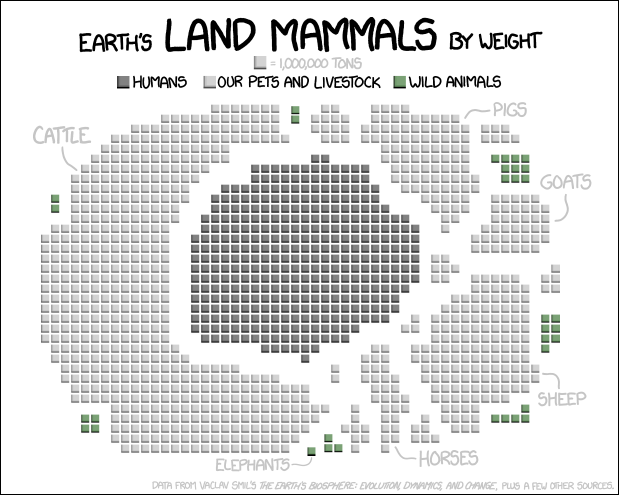
If you don't think all this has anything to do with humans, consider this:
Note that chickens, reptiles, insects, etc. are not part of this picture.
These are just mammals - the warm-blooded, mostly hairy or furry animals that can regulate our own temperature and have hair or fur.
There used to be a lot more kinds of mammals, during the ice-age era and interglacial periods. But we're all out of North American camelids, mastodons and mammoths, and most giant [whatever]s. Starting to run low on elephants of any kind, big cats, pandas, specialized island fauna, and .... well... all wild mammals that that don't thrive in human-controlled areas. Cattle have wiped out most of the food sources for indigenous traditional lifestyles as well as wildlife; the most notable surviving wildlife are those that have adapted to rooting around in our trash or browsing our hedges, and breed fast enough to tolerate being shot.
I am not even sure what to do when I see a bear anymore. (Saw my first one on the mountain this past week).
If a bear comes to visit, our first instinct is to shoo it away. It's not safe to encourage bears near human habitation; I'm absolutely clear I should not feed it, or tempt it to get too close by being careless with trash or compost.
But where do I expect it to go? There are some national park, tribal, and state forest lands within bear-ambling distance, if it can get past the dogs and guns in our neighborhood. But those landscapes are getting smaller.
I called off the dogs and thanked them for their support. The bear did not return.
No nation on Earth has set aside enough wildlife sanctuaries to support a viable, genetically diverse, resilient breeding population of any large mammal. If bears (and every other creature larger than a breadbox) are to survive, they will require some access to private lands to do so.
How do I manage a backyard that will feed me, and wildlife? How many fences are enough to keep the neighbors' dogs out, yet allow deer, moose, and bear to wander through? (Currently: 8' fences keep most critters out of the two garden areas; 4' fences seem to stop well-trained dogs but allow deer and, clearly, the occasional bear or moose.)
In Canada we saw mile after mile of 12' fencing along the highway, indented every now and then with turnstiles. At first we wondered if there was a prison nearby. Then we realized that the turnstiles pointed toward the wood, and were also 12' tall. They appeared designed to keep moose off the highway. If your fences do not create attractive 'alleys' for wildlife, they will share our roads. And while the occasional deer or raccoon roadkill is an acceptable collateral cost for a quick evening commute, a moose is big enough to inconvenience a semi-tractor. There are very few large, wild animals in our daily lives any more, at least in the settled, industrialized world where most of our human population lives.
We passed the tipping point where more people live in cities than in rural areas sometime in the past century - 1960's maybe? Was it at the same time that the average person lost all immediate experience of other creatures large enough to consider a threat?
The altering of our environment on a massive scale to support livestock tends to remove trees. While there are ways to restore soils using careful livestock management, mostly we don't do things this way.
The cheapest meats in the world tend to kill off the remaining wild animal populations. In the case of feed lot chicken, pork, and beef, huge nitrogen-rich dead zones are created downstream in what used to be the spawning grounds for most of the Atlantic's fisheries, not to mention the wildlife excluded from (or poisoned by) large plantations of
feed crops. Agricultural lands are generally established in the richest, most productive areas first - and in the case of North America, only after exterminating or excluding most of the wild animals that would otherwise browse and graze in those areas.
In the case of bush meat, the remaining wild populations are directly harvested for sale in the encroaching extraction and settlement communities.
So what am I doing about this today?
Well, let's start with "today" in the geological sense; this decade.
We love to eat, and a big part of our household income goes to food (especially if we want to be able to choose high-quality food that isn't treated with pesticides). Prior chemical exposure or maybe just nature and chance have made Ernie sensitive to MSG, and I don't handle processed sugars very well. So we eat healthy.
Note that 'healthy' does not mean cardboard or rabbit food - we are talking about locally-cured bacon grease to fry up some greens, or getting a cheaper cut of local grass-fed meat and making our own Philly cheese-steaks (with a little pepperoni, and some wilted greens and aged cheddar).
So we split the difference between store-bought, garden, and local farm produce. If I can do a favor to a local farmer or cheese-maker, it's worth my time. Agriculture uses tons of energy, so if we can learn how to do it better, without just hiding the costs by eating chemicals, or subsidizing expensive business models, that seems useful.
Energy usage can grow a lot faster than population, regardless of how we eat - lots of engines, motors, smelters, and furnaces are run on my behalf day and night. I don't have a lot of direct control over how manufacturing energy is used, except to buy more durable goods, instead of disposables.
I love things with replaceable parts - like how my Oster blender fits a standard small-mouth canning jar lid. I don't know how much benefit Oster sees from this clever design, as I am still using my grandmother's Kitchen Master station which is over 40 years old. So I am mentioning it to all of you - in the hopes that we can recognize and celebrate good, durable design. The brand has gone more toward disposables these days (most companies seem to think is the way to survive). But I'd still look at their high-end stuff if I wanted a new kitchen gadget.
I'd like to get away from the mindset that "cheaper is better," and back to a mindset where if you need it, you buy it to last.
In temperate climates, home heating and cooling is a big energy use. You probably know about our work with rocket mass heaters and other sustainable technology - we've been putting out books, resources, answering questions online through forums like
permies.com, and teaching workshops on how to acheive heating and other goals with a fraction of the fuel.
We would like to think that this work reduces deforestation and carbon emissions due to home heating (and cooling, in most climates).
We'd also like to think we're helping people learn how to use local resources (reducing transportation dependency), and problem-solve with thrifty principles like
- passive heat storage,
- building with natural and reclaimed materials
- passive and solid-state air circulation (no mechanical fans required), and incidentally teaching a little more about
- passive solar design,
- energy cycles and the chemistry of carbohydrate combustion, and
- new (old) ways to think about renewable resources that might help us outlast the non-renewable ones.
That's what I've been doing the past 8 years or so.
Today...
- I weeded and watered some tender areas in the garden.
- I checked how my water-saving methods (mulch, hugels) are working. Perennial berries, onions, deep-rooted vegetables, and rhubarb are looking good. Eating the weeds (lamb's quarters) with nuts and butter for dinner.
- I checked on the trees I planted this spring, and gave most of them a drink. Aspen looks happy, ceonothus less so (was planted last / late), mock orange happy in most locations, white poplar seems to be surviving for the moment. I also watered some larch that volunteered along the forest edge - I couldn't have planted them in a better spot myself, and hopefully an extra drink will encourage them rather than throwing off their survival clock.
- Ernie helped me get the Geo ready for summer use; now that the switchback road up the face has been graded, we will let our 4-wheel-drive car take a break and use the more fuel-efficient Geo for errands.
- I talked to Paul Wheaton about our workshop in September, and more digital media resources for people who want to save energy.
In geological terms anything in the next decade is basically "today," but for me as a human being I feel like it's important to do something, some little thing, every day. Because life's short and I don't want to sleep through it (tempting though it may be) - and because when you take the cumulative effect of all our daily choices, we human beings are a
huge and
sudden geological event.
We've all seen how the last 40 years' discussion of "we should do something NOW" is working out. It can always be done a little later, like procrastinating on the garden in spring or the plumbing repairs in autumn, until suddenly the ground is rock-hard and it's too late.
Doing something each day, something each year, keeps me on track to feel like I've done something with my whole life.
So if your schedule is open:
- consider one of the lets'-build workshops our friend Paul is hosting in Montana:
---- this weekend's solar energy workshop in Montana
---- our rocket mass heater workshop (cob style) in September, plus a week of innovator experimentation to follow
- Ask us (or better yet, hire us) to consider how to reduce your energy usage while the weather is warm enough for construction on a remodel or new heater. If we picked up three additional consultation fees this month, we could get some testing equipment we've been drooling over, and get some hard numbers on just how efficient and squeaky-clean our heaters are... and also prototype a larger model for those interested in a single heater for larger homes or greenhouses.
But you don't need something from my list.
- Go do one or two of those things on your own list. Like:
---- Fix something that leaks, like your car, house, or plumbing.
---- Upgrade something to save energy and money.
---- Tend something that reduces your dependence on things you disapprove.
---- Get outside, and fall in love with your climate all over again.
Or, you know, we could talk about boats and barbecues.
Maybe next week.
(technically, I think learning to sail or row is an excellent zero-carbon exercise as well.)
When you catch yourself counting problems or grievances -
- count your blessings
- count what you've done today to make a difference.
Imagine the difference if we each did 3 things today, as a 'retirement contribution' to the world of our future.
-Erica W